Thursday, January 14, 2016

Indian Play and Pray


Continuing on my Indian Play theme from last post below are the animals I was inspired to draw.  Turtle and moose are playing poker, buffalo is knitting and beaver and loon are having a game of pool. 
Yesterday Sophie and I got to Kumik.  A little late and a lot frazzled so it was disorientating to walk in from a packed day of work  into the calm.  The Elder was Bob Seven Crows and his partner Joanne Parent. 

Often they will share a theme and ask people to pass the feather and share their thoughts on it.  Sometimes I find this really frustrating.  I want to hear the Elder share their wisdom not some random person who might take too long to talk and might be boring... but what a lesson there is in that frustration.  I can share a joy or a sorrow with someone.  I can learn a totally new way of thinking about an issue or gain the comfort of shared experience.  I can have the calm to be in a space where everyone is respected.  I can remember that it is not all about me.

The theme was the smudge and the teaching was about intention.  We all smudge differently and that is ok.  It is the intent that we bring to the act that matters.  I really appreciated this assurance, that I was not missing out on some "right way" to smudge.  They also spoke about making due.  As they work in the prisons tobacco is not allowed and matches regulated, so they use cedar and count matches.  This story was a good reminder to appreciate that we do have access to these things.

They also spoke to the four sacred plants and the role of each of them; cedar and sage to purify;  Sweet grass to carry prayer; and tobacco to carry intentions.  They spoke to the offering of tobacco to the Elder as a means to carry the intentions for the discussion to be had. I had read about each of these, but hearing it again was really good.  It has made me think about that offering of tobacco differently.

Tuesday, January 12, 2016

Indian Play

First off, I just loved the title of this article "Indian Play: Students, Wordplay, and Ideologies of Indianness at a School for Native Americans" by Lisa K. Neuman in the American Indian Quarterly.  Indian Play sounds awesome and imagine having tea parties with buffalo or engaging in silly wordplay with a beaver? Actually, Tea Parties with Buffalos is going to be the name of my punk band.  Neuman defines Indian play as "...a creative process through which educated and highly articulate students negotiated the meanings of Indianess and produced new Indian identities."  I'd like to think we are doing some Indian play right here on this blog.


Giclee Canvas Print, Bison on Mustard Paprika, 8x10, American Buffalo, Southwest Colors, Bison Art, Buffalo Art:
Strangely I could find no pictures of Buffalo's
going to a tea party.  But I will make sure that
one is created.  The world needs it.
This article brought forward a number of new to me facts and ideas.   Firstly the author is interested in an American school called Bacone College.  She notes that it was established in 1880 by a Baptist minister who wanted to train Indian students to be teachers and preachers and that the school highlighted the "Indian" nature of the school as a positive factor when raising funds.  As part of this focus they also hired Indian staff and provided curriculum and activities in "Indian arts, histories, and cultures" so that the students, for the time, had an unusual ability to "publically engage ideas about what it meant to be Indian and educated." 


In the article she explores the history of the school through the words of the students gathered either from the student paper or through interviews with former students.  She is particularly interested in their use of wordplay and humor as a means to explore this issue of identity.  This space for Indian play was complimented by a collegial environment, which was reportedly free of violence and where students were not isolated from other adult Indians or surrounding Indian communities.


She mentions that some students were fearful that, "if they were educated they might no longer be considered "Indian" by their communities" and that some faced teasing when returning to their home communities.  The students played with these themes through two long running fictitious newspaper characters, one the stereotyped ignorant Indian who couldn't understand why anyone would want an education and the other "educated" Indian who defied the stereotypes of that role (and was stupid).


Neuman is careful to note that this Indian play does not imply agency or resistance on the part of the students.  She sees that their dialogue was primarily an internal discussion on the changing status of the students themselves, but at the same time she notes that in some cases, cultural persistence can also be read as resistance.  We are still here.


Given the nature of the school, it also brought together students from different tribes and was thus  unintentionally a space to explore early-pan Indian identity, with students sharing cultural information with each other as well as exploring similar challenges through the Indian play.


I  also personally found this article interesting, as the family history was that James Brady Jr  (Jim Brady) was accepted into Oxford and choose not to go as he felt it would make it difficult for him to maintain a connection with the people.  It makes me think about how difficult it must have been for someone like him to go away into that very Europeanized space and what that would require that person to give up in terms of identities.


What is your Indian Play today?


Monday, January 11, 2016

Moose teeth all the way


This drawing is inspired heavily from the book "Ojibway Animals" by Jason Adair that I picked up at the Art gallery.  While Ojibway is probably the most prevalent of our various types of indigenous background, I hadn't done much exploring there for some reason.  This book inspired me to think about that part of our culture a bit more.  I was struck to by the similarities of this art style to the west coast styles of animals.  I really like the pictures in this book and the colors were very inspiring. It is a baby book and would be fun to share with a little person as well.  I think I will try to create a fabric piece using this inspiration.  I guess I just got caught up in plains styles.  Moose teeth all the way.

Have been reading Bustle.com lately and find myself a bit surprised by the mix of celebrity gossip and moments of thoughtfulness.  I wanted to share this article on body positive/feminist social media personalities to follow.  I liked this one where plus sized women shared their most body positive picture of the year. I was thinking of this article as I was at the pool in my bikini not feeling too bad about myself. I also enjoyed this article talking about plus size privilege.  Always gotta check the privilege.  I have also found a number of new to me plus sized stores through browsing their articles.  I guess there is a teaching there.  We are all made up of moments of the sublime in between gossip and everyday worries.


Friday, January 8, 2016

Who made this body?

Spirit Wrestler Gallery: Art Exhibition: Celebrating 45 Years Cape Dorset Print Collection:
Spirit Wrestler Gallery: Art Exhibition:
Celebrating 45 Years Cape Dorset Print Collection
In my reading and thinking over the break I came to the realization that even if I cannot wholy understand why I am the way I am regarding my body, that I can still acknowledge and own the reality of what it is right now.  I don't know why, but I am broken in some very specific ways. I was thinking this through and it seemed like a poem to me.


Who made this body?


Who made this body?
I remember no catastrophic moments
where dismembered bits
were gathered together
and roughly rejoined
yet it is broken

Who made this body?
maybe a 1000 tiny fragilities
and one insignificant incident
that set the whole thing to fracture?
patched enough to keep going
yet it is broken

Who made this body?
memories I carry in my blood?
the abuse and sorrows of a people?
betrayal of their gods?
the deaths of mothers and fathers?
gaping wounds held together by symbols and alcohol
yet it is broken


Who made this body?
with its revulsion for touch
fears of intimacy
and ballooning shell
a broken system?
a mother?
an inborn weakness?
medicated enough
talked enough
to keep a person shape
yet it is broken


Who made this body?
fairy tales that were lies?
truths that were hidden?
words unspoken?
but I speak and try for truth
yet it is broken

How can I not know
The thing that dominates so much?
What am I missing?
Can I ever fix what I don’t understand?
the kookums game to the eyes to see the question
give me the courage to look for answers
remind me to give this time.
and while I may be broken
I don’t have to journey alone

Thursday, January 7, 2016

In defence of things that don't need defence

I think it is probably a left over idea about protestant work ethic but sometimes I get down on myself for the amount of time I spent playing clicky computer games and in thinking about this, I was struck by all the teachings that can come out of these simple activities which may appear useless on the surface. 


In particular, I have lately been re-obsessed with Bejeweled Poker where you try to get hands of matching colors.  While simple, these is a certain amount of strategy in planning how things falls.  More than that I learnt a lot.
  • Sometimes the board looks awesome and doesn't deliver.  Sometimes it looks awful and does.  Looks can be deceiving and worrying about it either way doesn't do any good.
  • Sometimes you have a very clear plan and the fall of new shapes destroys it.  You can strategize, but you also need to have a back up plan.
  • Sometimes you can have runs of amazing luck and it is tempting to get sloppy cause you are that awesome.  Sloppy play can ruin even good luck.
  • Sometimes if I play when I am very tired the game becomes very hard.  Sometimes you need to go to bed and come back to your tasks when you are more rested.
  • Often I play better when I let my intuition guide me.  Listen to those little inside voices.
  • Often I play to distract myself from other things that are worrying me.  Sometimes the answers come when I don't look at them and give them space.
  • Sometimes a game is just a game and that is ok. 
So what is your guilty pleasure?


I also had some links I wanted to share.


The first is a piece about appropriation of culture by a fashion house and commoditization of indigenaity.


A piece about Native Max an indigenous fashion magazine.  I have been meaning to investigate this one for a while.


This coverage of the addition of a trigger warning to the government web sight for the inquiry into missing and murdered women.


Share what you are discovering and enjoy your guilty please today.


Wednesday, January 6, 2016

Myth making and keeping

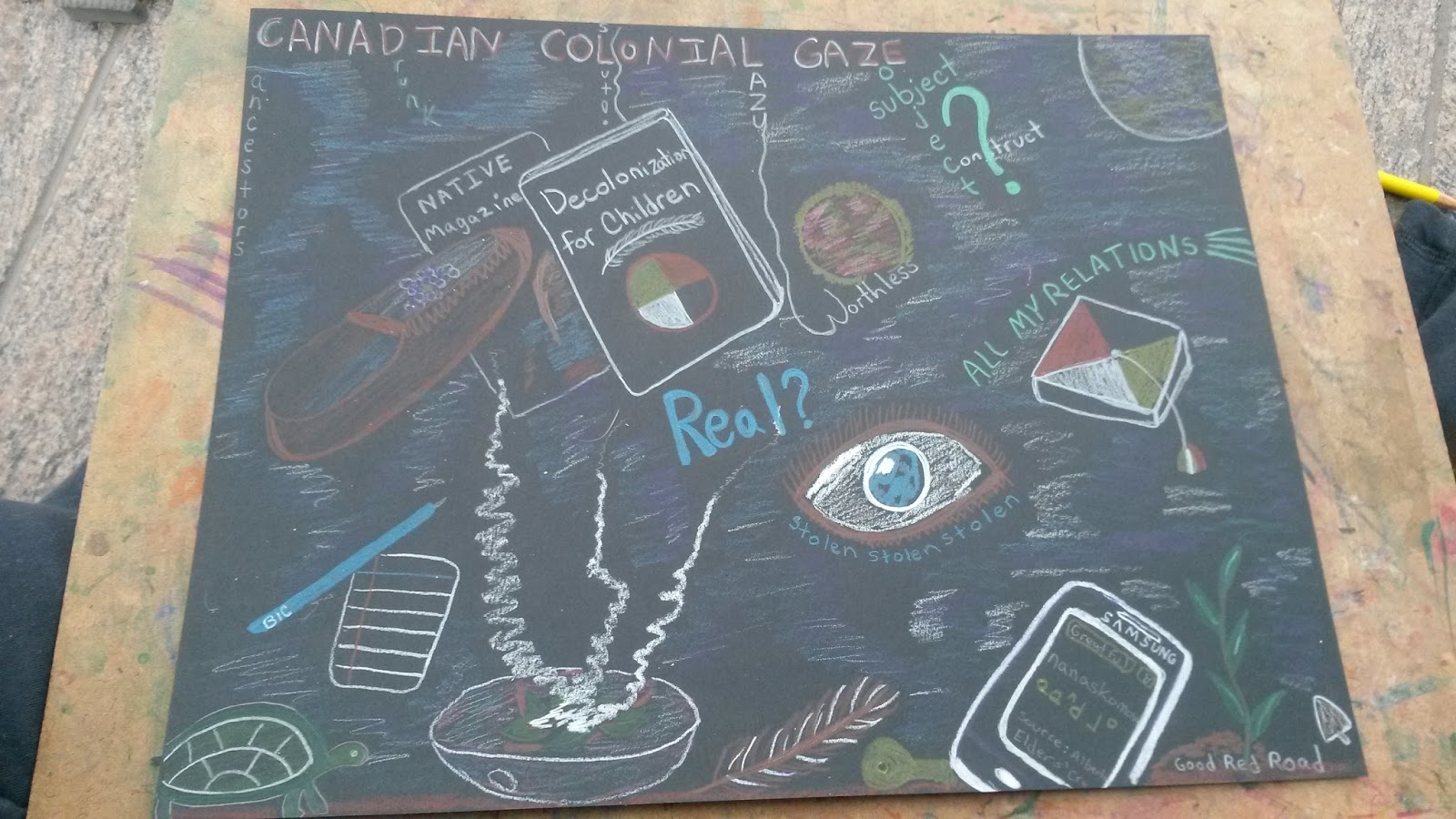
Over the break I read "Re-Constructing the Colonizer: Self-representation by First Nations Artists" by Shandra Spears.  This piece inspired me so much that I took time from reading and created a picture to respond to the Canadian colonial gaze she describes. I tried to represent the stereotypes, both good and bad, of indigenous peoples, and the reality of a modernized people/culture who are alive and changing.
In this article she begins by examining the tensions of producing humor that balances the "laughing with" and "laughing at" where laughter can be a tool that reminds the other that we (indigenous peoples) are still here and thriving, but where these moments can also be co-opted or perceives as performative caricature.  She speaks to the dueling nature of art as educator, healer, politician or just  a thing in itself that is beautiful or humorous.  Does art/humor without meaning betray the indigenous people?  Does the indigenous artist/comic need to represent a pan-Indian experience or can they personalize their creation and connect to the wider indigenous experience as a colonized and oppressed person?  She also poses the question as to what comes first, the artist or the indigenous person and she raises some really interesting questions as she covers this ground.

She expands the discussion to addresses the same questions from the perspective of an indigenous feminist.  She explores how you can tell stories of victimization, while not creating victims.  "Some stories can erase us and make us fell invisible... Some stories can hurt us or limit our sense of what is possible.  Some stories can make injustices visible that have been ignored or forgotten.  Stories can set us up to reach for an imagined Native identity or female standard of beauty.  Stories can also elevate us."  Clearly how we tell our stories matters and it is all stories right?

The middle part of the paper gets into the construction of the mythology that has shaped the lives of indigenous people called "colonization".  She says that "This mythology is so strong that a colonizer can walk past thirty Native people on the street, and only the see the one who is passed out on the sidewalk, because that one Native person confirms the colonial myth system." She concedes that if they came by in a canoe and buckskin they might also be recognized.  I think about that sometimes as I walk. 

She describes how the colonial gaze is similar to the male gaze in "its assumption of maturity and superiority and in the way that it objectifies and eroticizes that which it captures."  She notes that we can get caught in seeing ourselves in this gaze and then reproducing these same ideas of worth or beauty.  We can get caught up in judging other indigenous people's with that lens or trying to refute it in our own lives by working extra hard to show the colonizer that we don't fit a certain stereotype.  This passage really struck me given my response to the Winter Gathering a few weeks ago as well as my own struggle in claiming my culture as I was "not passed out on the street corner" or "living off the land" and was thus not a real indigenous person.

She translates this self gaze problem back into the creation of art, "we have a strong cultural traditional or humor, yet we want to avoid trigger colonial myth-systems.  Our artistic work is created around an obstacle course of colonial misunderstandings, cultural protocol, ethical concerns, community lateral violence and funding categories which sometimes attempt to determine the "Aboriginalness" or the work."  What a great articulation of a complex issue. 

From this discussion she segways into a more academic discussion around the creation of meaning systems which is interesting.  She then comes back to focus on the "Canadian Colonial Gaze" which inspired my drawing.  She outlines the multitude of role an indigenous person might be ascribed too in any moment and the interconnectedness of these stereotypes to the modern constructions of racism in Canada which are rooted in the deep mythologies that allowed for the killing and dispossession of millions of people as they were seen by the colonizing gaze as less than human.  At the core, these ideas continue to exist in the modern questions about who is "Indian" and who is not.  She covers how this myth was strengthened through early photograph of indigenous peoples and then moves back into the academic constructions of myth and the "safe other" (thanks bell hooks)
Christmas day outing to the park
In concluding the article she returns to the question of creating art/humor and how the very creation of these things situates the maker in a particular historical context, raises questions of identity, and may ultimately empower the creator to challenge these perceptions and historical creations.  There was a lot packed into this article and the contrast between the more personal chatty sections and the more traditionally academic text worked well.  The author situated themselves well within the discussion through the use of a few personal details.  This was a smart, challenging paper that touched on a lot of issues I have been exploring slowly here and also proposed some useful ideas and frameworks for continuing the conversation. 

As I was creating my picture Runa asked me what I was drawing and from my answer she understood that I was creating a story with pictures.  She later asked me to "read" it to her.  We talked about the words and symbols I had used.  When I mentioned that the turtle on the bottom left hand corner represented our brother and sister animals and moved on to the next item, she directed me back "Mom, remember that turtle is special cause he made our land."  These moments, when I know it is getting through to her, warm my heart and give me the energy to keep going.  The myths matter.  How we tell the story matters.


Tuesday, January 5, 2016

Weeping woman

^Weeping Volcano Woman by Norman Tait, Nisga'a artist:
Weeping Volcano Woman by Norman Tait, Nisga'a artist
Welcome back to regular life. I forget sometimes, that even "good" stimulation can be too much for Sophie.  We had a great Christmas eve morning visiting my office and walk home in the +17 weather.  We survived dinner and gift opening - sometimes a pressure point, when she accidentally broke her gift for Runa.  This left Runa in tears, which led to Sophie lying under the trampoline crying and screaming that she would be better off dead and that she is a terrible person.  It sort of took the merry away.  Even after we got her calmed down, it stays with everyone.  She refused to leave the house for a couple of days and we ended up doing things without her which further upsets Runa.

That said, we went to the park on Christmas day, shot each other with nerf darts and played outside.  We made a magnificent snow fort and played a lot of card games.  We visited the art gallery a couple of times and made up our lego kits.  I made a collaged buffalo and a gingerbread house.  We painted and decorated both of the girl's rooms.  So there is always the good in between the moments of sad.  Getting back into school again has been hard for Sophie but she has her Physiatrist appointment this week which hopefully will help her adjust her meds and we are setting up a whole bunch of other supports to will see what helps her. I am taking her to see some Elders next week and get their views as well.  Their previous assessment was that maybe the blood memory is strong in her and she carries extra because of that.


I am trying to reach out to my Kookums who have walked on for support.  Neither of our parents care at all.  Joel's did not even phone this Christmas.  It still hurts me how little they care.  But the ancestors are always there and I appreciate having access to this resource now.  It is comforting to know all the experience they have and can bring to my current situation.  More so, as their perspective on time is so different it helps me align things for myself with a wider lens. 


We had our circle times as a family, talking about the sacredness of our bodies, for Sophie this was a discussion about growing up that made her very uncomfortable, and more broadly we talked about what better habits we wanted to focus on in the next few months.  I used passages from the Kim Anderson book "A Recognition of Being" to guide these conversations.  I read a lot and have a number of interesting articles to share in the next few days.  I hope that there was some good for you in this holiday.