Thursday, January 8, 2026

Rainbow Bridge - Our Missing

As I worked with our youths over the past few years I was also reading the headlines of more missing Indigenous peoples. Would one of these youths become the next loss? Who was missing from our circles of learning? We cannot tell our stories of economy and resilience without including our missing. This doll is my dialogue with Auntie Wendy-bah (Metis) about this loss. The bridge is a rainbow made of beads. The symbolisms with the doll reflect the teachings of this spirit journey from Basil Johnston (Wendat), Anishinaabe Nokomis Martina Osawamick and Elder Barbara Brant (Mohawk).


Monday, August 11, 2025

Embodied sensory research: Gitchi Kami and working accross time and space

Preparing the rabbit yarn

This is my experiential and creative response to Johann Kohl's book "Gitchi Kami" published in1860. Kohl was a German travel writer and ethnographer who was fascinated by maps and how cartography impacted movements, economics and trade. While he is a European of his time, his book is an excellent resource for a number of reasons. Firstly Kohl was well travelled and educated. When he compares the Anishinaabe ways his comparisons are often to peasants in other countries or to classical people, in that they are a people who exist before civilization. The result is that his analysis is not racist per se - often more classist i.e. he notes the similarity between the Norwegian peasants and Anishnabe folks around their lack of interest in a cash based exchange system. 

He was an excellent observer who provides meticulous details and drawings of what he learnt. As a result, even where he did not understand what things were or where his explanations are wrong or problematic they can be re-interpreted with Indigenous knowledges and contribute to our learning in the present. His personal motto was that there should be no models without observation. He wrote many travel guides and he interacts with a large number of related European intellectuals of the time. Germany was mad for information about First Nations Peoples and his trip was financed to benefit from this interest. 

Kohl lived with the Anishnabe peoples for four months. From the teachings I have been gifted on good protocol Kohl was

Winding the rabbit yarn
mostly culturally appropriate. He learned the good way and build trust which allowed him to gather better information, be gifted with many stories and be included in more intimate spaces, including ceremony. He paid local folk fairly for his care, gave gifts and offerings of tobacco. In my opinion, with knowledge of Indigenous teachings, there are many other possible layers of information to "read" in this text. His observations and interests are very wide from the economic system, the roles of women, the organization of society and policy, values, education, technology, oratory skills, musical notation, numeracy and political questions.

As I sat 175 years later, absorbing this tome and gifted with the teachings of an Elder, I see the strategy, hope and love of the Ancestors to pass on their knowledges. While many folks allowed Kohl to  record the stories and symbols he was shown, but this information was often coded so you could copy but not "read" the information. Isn't that a metaphor? For folks interested in learning more about ceremony, our stories, innovations, this is an excellent source. As an economist I appreciate his  discussion of the economy with real numbers and concrete examples.

Weaving on a picture frame loom
One example in the book speaks to the baby blankets that women would weave from strips of rabbit fur. I decided to try and make one. As I worked I tried to think about the lives of these women: their roles, agency and spirit/kinship economics. Like Wendy-bah's dollies, these baby blankets represent economies where "value" comes from the care, knowledge, stories and love that becomes part of the spirit of the item. 

I began to experiment with some fur scraps I had, garden twine and a picture frame for the loom. For practicality I planned to weave four squares that could be sewn together for the blanket. Using Kohl's description and the knowledge shared in a YouTube series by archaeologist Lynnette Etsitty,  Weaving a rabbit fur blanket - Cleaning yucca fiber (part 1 of 4) - YouTubeI gave it try. It was not always pretty and the squares were not totally successful, but this blanket became a thing of community. My cat Ginger was a faithful companion as I worked. I was accompanied by the many neighbors who stopped by, shared their lives and witnessed the creation. When I needed additional fur, folks in Bear Circle shared what was needed. One of those furs was there at the first Truth and Reconciliation day. I also worked on this project during ceremony to capture the love and intention of community.

Bear Circle Baby
To honor this, the blanket was made for the Bear Circle Doll who is the symbol of our commitment to the future generations. This doll comes to ceremony with me sometimes. To make their transportation easier I made them an urban tikkanogan (baby carrier) which is made out of garbage I found in the Byward Market area, duct tape, leather and sinew. The blanket was gifted to baby at the 2024 Winter Solstice Bear Circle.

This book really changed my ideas about the possibilities of engaging with these older texts written from a European perspective when we have learnt the teachings that allow us to "decode" or recontextualize what was described. This blanket and the technical knowledges to make it challenged me and it isn't the best blanket. I was honoured to work with Indigenous women, across time and space to care for the future of our communities. I can put forward no more eloquent summary of embodied sensory research and the value this approach could provide for our current thinking about economics and making.

Thursday, August 7, 2025

Embodied sensory research: Wendy-bah's dolls and working across generations

Images found here
On the passing of my Auntie Wendy-bah I was entrusted with hundreds of the dolls that are her gift to the people. These dolls embody her philosophy and speak to many Metis ways. Wendy-bah found materials for her creations in what others would discard as garbage. In her own words "Each of these little dolls has been lovingly handcrafted with recycled materials to create something new and wonderful. No two are exactly identical; just as we are all unique, each doll has slight variations in size and colouring, age and style. Each individual doll is different, and reflective of the wonderful diversity of us all."

Frankie 
Her instructions for us were ensure that these dollies and their story got out to the people. I started by sharing some dolls for gifts maybe adding small items or a bit of beading. However, over the years I started adding accessories and Indigenous symbolism as a means of practicing the teachings I had received from the Elders on these matters. I found this time of reflection and intergenerational dialogue helped me to ask different questions of my sources and integrate research at a deeper level. These dolls have gone to babies born in the Bear Circle and as gifts to dignitaries and Elders. The last conversation I had with Wendy-bah, on this side of the rainbow bridge, was about my dream of the grandmothers and the research work I was planning. As we said goodbye she told me, "I have so many ideas for the next time we speak." 

During my sabbatical, when I hoped to write and synthesize my research, I sat in the garden and sewed. I sewed in relationship, in protest and in research. I decided to use some of these dolls to create physical manifestations of my intellectual ancestors and their work, and to make dolls for each Matriarch in my paper. I will post these creations and my thoughts on embodied research but I cannot start that writing without starting with a Ninanaskomowin for Wendy-bah's love and gifts.

Tuesday, December 3, 2024

Changed the rules the very next year

When did it start?
Changed the rules
Very next year

Promised us power
Under stones
Magic incantations
Disrespect
Made superfluous.

There when the planes grounded
When the world stopped
When the greed
Strangling our people…

Geometric dangers
Akshoga* 
What to learn next?
Change the rules?

Indian Time
Surreal survivance
No start
No end.
There when….

Pehiw Wandering 24
* Grandmother in Mohawk

Didn’t seem much

I wanted nice
Simple
Logic
Didn’t seem much

I wanted to help
Make it better
Safe
Didn’t seem much

I wanted respects
Re-con-cilliation
Let ideas speak
Didn’t seem much

I wanted futures
Songs of truth
Seeds of hope
Didn’t seem much

But seams fray
Tattered rags
Made to “civilize”
Not-yet-corpses
Who keep wandering
Who keep wondering
Who refuse to nice.

NanaBjorn Wandering 24

Too dumb to see

Did it
As you set out
Too dumb to see
“Just enjoy the journey”
Really meant
-that’s all you get –

Never allowed to arrive
Unless scape goat needed.

Too dumb to understand
We measured productivity
Built our own chains
Believed the progress
Better to come
-just not for us!

Ghost ridden* 
Those stories
Heavy histories
Too dumb to see
Our existence here
Wounded with the roots of that**

NB W 24

* For some reason my brain almost always replaces gaslighting with ghost riding

** Beyonce and Jay-Z, IDRIS “American Gangster”

Killer with a calculator: Thinking about shame

Why shame so cheap?
Tried to find solutions
Left dem buildings
Left dem binaries
Set some fires
Ripped whole words
Reclaimed body
Rebuilt mind
But still #$*&@ * 

Why shame so heavy?
Tried to run
Tried to fight
Left some folks
Burned them bridges
Hid my tracks
Tested body.
But still #$*&@

Why shame?
Disciplined
Body
Mind
Spirit
But still #$*&@

Aberrant
Anachronistic residue** 
Made savage by modernity
Killer with a calculator
MacBeth
Sings same
Dream same.
still #$*&@

Always #$*&@?
But now
I know!

NanaBjorn Wandering 24

* Jay Z “Story of OJ”

** Rifkin - "Beyond Settler Time"

50 Cent

50 cent
Don’t buy much.
Can’t get work
Gotta take work.
Count yo money
Cause sometimes
21
Under cover 12

We stupid?
Temporal guardians
Gangster orators
O L D school
Economics masterclass?

No MBA
Just glad I aint MIA

Can’t get it to work?
Gotta make it work.
Vandals stole the handles?

Roll up your sleeves
All the hows
Whys
Songs of burdens share.
I text
“Medicines lit”
Fired mine
With the love of circles
Uncomfortable truths.

90 proof. Dip our arrows.
50 cent
Don’t buy much
Can’t get respect
Gotta take respect.
Counting my wealth
But I aint done yet.

Nanabjorn Wandering 24

- Nia’wen to 50 Cent, Bob Dylan, Kayne West, Mark Rifkin, Charles Eastman and the Indigenous holders of our knowledges.

Notes on Rifkin: responding experientially

As part of my explorations of the space of experiential research and policy making I am trying different experiential and creative ways to respond to academic text. These poems and the summation text before form my response to ""Beyond Settler Time: Temporal Sovereignty and Indigenous Self-Determination" by Mark Rifkin.

I think that the language and subject of this book made it work well for a response in poem/rap. I listened to a lot of rap over this time and that multi-layered discussions of race, economics and hope also influenced my response to this text. This book gave words to so many things I could not yet name. He wove threads through time, traditional teachings and the thoughts of some very gifted thinkers from our Nations. I read it  "Accounting for Genocide: Canada’s Bureaucratic Assault on Aboriginal People"(by Dean Neu and Richard Therrien) in mind - how these alignments to Hat* time are weapons against us as peoples - holding us in stasis.

We need to reclaim our temporal sovereignty and we do it by practicing - like we did in the Bear spaces - as we gather, make decisions together and solidify our relationality. We are connected peoples and we are temporally sovereign when we live our ways. When we find new/old ways where we live now! 

This experiential engagement with a text feels free - not a summary, but a wholeness. I am interested to learn from other if this is a useful way of fast info transfer or just pretentious bullshit. Let me know what you think. Aho Data Bear.

Addendum: Matt Christman of "Chappo Trap House" a great thinker of our time, who has been quiet for a year after complex health challenges has made his return to public with poetry

List of poems

*Hat in this context is a term for the settler ideas about governance, economics and time and so forth.

Coda: Deferences: responding to Rifkin

 As part of my explorations of the space of experiential research and policy making I trying different ways to respond to academic text. This poem is part of a series that is responding to ""Beyond Settler Time: Temporal Sovereignty and Indigenous Self-Determination" by Mark Rifkin.

Coda: Deferences: responding to Rifkin

Missing collectivities
we mirror
skeleton economics* pg 182
Afraid.

Temporal tongues
demand audience
geography be DAMNED!
Gathering is survivance

Else
[worn out
detextured
circle deformed into cog]

So light medicines
learn silences

[shame
sha me
has me
ash me
a mesh
she ma
Not my letters
not my words
A "normal" without tommorrow]

So light medicines
and learn silences.

Data Bear Gathering 24

* pg 182

Prophetic temporality: Responding to Rifkin – Chp 3

 As part of my explorations of the space of experiential research and policy making I trying different ways to respond to academic text. This poem is part of a series that is responding to ""Beyond Settler Time: Temporal Sovereignty and Indigenous Self-Determination" by Mark Rifkin.

Prophetic temporality: Responding to Rifkin – Chp 3 

Prophetic temporality
Persistent possibility
Sumac red
Don’t need chains
When roots work too.
S      I      L     E      N      C      E
Retexture possibilities
With hopes and continuities
Take up
Unfinished stories.
No longer
Economic migrants
In our own lands
“Rationalism”
Poisens failed.
Return immune
Regenerated
Gardens
Seeds
Visions
Witnessing
Lived knowing
Reconciled to now.

Nana Bjorn Gathering 24

Growing in the ditches of greed: Responding to Rifkin – Chp 3

As part of my explorations of the space of experiential research and policy making I trying different ways to respond to academic text. This poem is part of a series that is responding to ""Beyond Settler Time: Temporal Sovereignty and Indigenous Self-Determination" by Mark Rifkin.

Growing in the ditches of greed: Responding to Rifkin – Chp 3

Duration Dense
Perversity
Existence
Persistence
Economic stasis* 

“Trust us”
Permanent record
-anomaly-
Failed “to develop”
Cause I aint no dry snitch

Silence
Ground deep
Emotional truth
Snotty nose
Strategy stories

Tongues
Reckon with possible paths
Mathematical necessity
Temporally sovereign
When we live OUR ways
Sense make
Together
Discern
Red paths
Faint
In days of pain.

"Disabled”
Stretched
By multiplicities
Cheeze grater world
Blooded –
No finger prints
Horizon dancer
Body a garden
Growing in the ditches of greed.

Data Bear Gathering 24 – as the skies darken for a storm that was intense and brought clouds only seen a few times before.

* pg 100 “Not yet doing something”

Friday, November 29, 2024

“Duration of the Land”

 As part of my explorations of the space of experiential research and policy making I trying different ways to respond to academic text. This poem is part of a series that is responding to ""Beyond Settler Time: Temporal Sovereignty and Indigenous Self-Determination" by Mark Rifkin.

“Duration of the Land”: Chp 2 

“Stained by colonialism” *
Dirty rags
On bodies that remember
Who transverse stars
But breathe

The lands that sustain
The time of rocks
The wisdom of rivers

Held immobile

Cause they can’t see
When we skim waves
Here/there/tomorrow
Inheritances/relations

All the same water.

Nipon Kona W 24

* Pg 75 Dale Turner

A little bit human

 As part of my explorations of the space of experiential research and policy making I trying different ways to respond to academic text. This poem is part of a series that is responding to ""Beyond Settler Time: Temporal Sovereignty and Indigenous Self-Determination" by Mark Rifkin.

A little bit human – Reference to Rifkin pg 38

Winnowed
Hundreds
Human sacrifices.
Warriors
Denied a “war”
By pen
By tongue
By design
Lincon
Personally
Choose
Fast death
Or slow?
A little bit human
When it suited.

Nipon Kona W 24

Reading Rifkin: Begins

As part of my explorations of the space of experiential research and policy making I trying different ways to respond to academic text. This poem is part of a series that is responding to ""Beyond Settler Time: Temporal Sovereignty and Indigenous Self-Determination" by Mark Rifkin.

Reading Rifkin: Begins

Consternation?
Temporal aberration?
Quotidian tales
Float in silence
Healing cacophony
Doing it our way
Dreamed pathways
Making room
Ancestors join
Sink
Sync
Ghost ridden
Haunted skins
Lost it all
-Only savage left –
False neutralities
That pretend raw
Is “the modern way”

Gangster Granny
Ladders don’t get you high!
Temporal indignities?
All them layers!
You gotta count
But I know.

Temporal Drag Queen
Hybrid monster
Teller of un-intentional truths
“Survivance is our time”

NB W 24

What you gonna do?

What you gonna do?
everything you chased...
Eagles* said it better,
poet warriors

-Arise-

we aint got time
pens of fire
golden voiced cousins
come close
time to polish
songs from dreams
prophesies in bones
truths in ink

"We may lose we may win"*
be by again
and again.

What you gonna do?
Everything you chased....
collateralized risk instruments,
models fantasy
in perfect detail

Potemkin show girl fantasy
sand castles
can't house soldiers
can't feed slaves
can't sell lies.

What you gonna do?
everything you chased
between your fingers
between your breathes
right in them questions

NanaBjorn Wandering 24

* Eagle lyric to "take it easy"


On Wendybah's birthday

We are star people
made of stuff
Dolly sewn by Wendy. Accessorized by Elizabeth
left overs
you stitched
with steady hands
cause you know.

The thread pulled tight
transforms.

Your vision
visits the unborn
celebrated in circle
passed
To Grandmothers
Leaders
doers
thinkers
makers
transformers
like rainbow bridge

Your last gifts
stiches to add
gardens to cherish
leftovers
to give new live.

Nipon Kona Wandering 24


Tuesday, July 16, 2024

Bear Pin Journey


First Bear Pin


When I was given the challenge of "making the Bear real" with a team, I needed to think about how as a team we could center certain key perspectives while in action? This includes key concepts to Indigenous methodologies such opening spaces in the circle for other voices and ideas such as 7 generations which we thought were important to hold close as a team. We tried a couple of different approaches including a Bear Team Tracker where we identified common goals we were working towards and shared progress regularly.

However, when it came time to assess my team on their yearly deliverables, the structures of the government review process were not adequate to capture the journey of my team and the growth of the individuals. We needed another way to acknowledge the growth of the folks in the circle and the roles they were given by the Elders. I began researching but many of the recognitions of this kind are military focused (although there are much older civil servant examples with lots of nice hats). It was also important that this symbolic representation be respectful to the different Nations we come from and their symbolic practice. I wanted something folks could wear with their regalia should they wish.
 
One night my child was watching videos about nuclear submarines by Smarter Everyday. While far outside of my normal interests I was hooked. Since these ships go dark for many months everything onboard is meticulously planned and considered. One thing that stood out to me was the cross training. Like a SEAL team, every member has a specialty but is also trained in all other roles. This is an important part of your time on the ship and at the end the sailors are awarded a dolphin pin. While the military link was uncomfortable, the more I thought about it, and the way the civil service is based on the military model, I started thinking about a bear pin.

After speaking with the team I decided to move forward with this idea. But the pin to use was obvious to me. The story behind the pin. I though the question of my child "why does that fish have a bear on it's bum?" was really a good symbol of the work we were trying to do to shift our perspectives. To honor the role of this story it was also included in one of the modern teaching stories about economy that I am working on.

Each pin is unique for the person and includes a marker of their years. For example with this first pin
  • The person was identified as our "Circle Keeper" which is represented with the red circle
  • In recognition of the time served, wood leaf =2021, snail = 2022
  • Colors are chosen based on the color preferences of the individual and times I spend with the Medicines during creation. I try to work on part of the pin in another Bear Ceremony.
  • Bear is in motion and connected to the water
These Bear pins are awarded in the Bear Circle with the guidance of the Elder. In the time since we awarded the first Bear Pin I have been surprised to see how this practice has rippled and further enriched our practices. For example, after a year of learning with the Bear we found that we wanted to align ourselves to the rhythms around us.  As a result we introduced the Bear calendar to try to be more aware of the seasons and how they impact us, our communities and all our relations.  This included some different Bear Pin activities to recognize the hibernation time.

Sock monkeys, Zizek and sore behinds - Draft Chapter 9

This is the last story this old Bear can write. It has been quite a journey – re-remembering, learning and navigating stories. Bear was privileged to carry the tongue and pen this far. Bear can’t wait to see what the new ones will add to the Bear’s stories.

This journey has been a lots of learning. What makes a good story? Is it a body leaned in close? A voice turned whisper? A teaching that worms around your mind and heart for years? Something that stays with you long after the fire is ash?

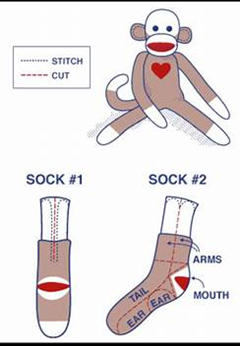
Well, over some years, this Bear has been able to learn and grow with bear cubs. A long ago Grandmother had sewn a Sock Monkey. This Sock Monkey lived an active life in our cave, keeping the dolly antics under control, wearing many hats, fighting off inquisitive beagles and teasing jealous felines.  One day, the whole bear family was out at the market when our little cub gave a terrible cry. Following their paw, we turned to find a nearby shop wall was covered in the skins of the sock monkeys! Worse, the sock monkeys had been sewn into socks and hats for the two leggeds! Being sold without any proper respects! Well now…many cubs tears fell for those lost monkeys! Even today the diagram above is easy to find on the internet. It shows how sock monkeys can be dissected and sewn together to cover the human foot.

That little cub had got a lot of knowledges eh?

So we tried school. It is what they tell us the cubs need. It didn’t work out so good, but we first started wondering in kindergarten when we opened our cub’s little backpack to find it full of books on agricultural economics, postmodern thinkers and philosophers! That little cub consumed these texts with a passionate intensity. She read them upside down, inside out and backwards – with the cold eyes of innocence. Somedays Dolly was Arendt and Teddy was Eichmann. They usually met for tea and it was all very polite. But watching our cub live out their learnings gave this Data Bear confidence as some texts don’t wield to the conventions of reading them right side up!

That little cub had got a lot of knowledges eh?

Little Bear loves the shiny and sorts my treasures. Their eyes land on the pin with a Bear and Fish[1]. “Mama, why does that fish have a bear on its butt?”

Well, there’s nothing to add - that’s the best story I ever learned from. Ho.


[1] Reference that this pin in the inspiration for the “Bear Pin”?

Monday, July 15, 2024

Finding community: the Kumik National Lodge on Algonquin lands

I first came to Kumik 15 years ago.  I knew that my family was Métis but that had little relevance to my life.  I don’t remember the Elder but the story they shared that day became an important part of my life philosophy and teachings for my children.

About ten years ago, as a result of a conversation with an Elder brought in by IRCC (from Kumik), I made the decision to fully acknowledge my Indigenous heritage.  I had long held back for this step thinking that as I got where I was with white skin privilege and didn’t have any cultural knowledge that I should not identify as Indigenous.  That Elder gave me the teachings and stories I needed to start my internal decolonization work.  As a result I learned about my family, our traditions and started learning Cree.

As there was no downtown lodge, whenever I could, I would get a taxi and cross the river to the Kumik.  I started meeting Elders occasionally for one on ones which filled my bundle and gave me a chance to learn about ceremony, protocol, teachings and stories.  Sometimes I brought my children and we attended many of the workshops making drums and other items that we still use.  This time allowed me to come into community, ask questions and learn with the Elders.  

This knowledge helped me to raise my children with good teachings in a healthy Indigenous way.  This was possible because of the welcoming environment for those of us who don’t have teachings or language or connection.  The Elders and people I met did not care if I was Indigenous enough, only that I was open to learning in a good way.  This community opened up other Indigenous resources to access. 

As a result of this growth, my child and I were at the closing ceremony for the Truth and Reconciliation Commission.  My child was brought forward to represent the future generations.  Through the Kumik and related community, this child knows their Métis heritage and the good red road, they were there that day and carries those stories and the promises made into the future.

This regular contact with Kumik and the lack of progress on Indigenous issues at my previous department were key considerations in my decision to move to ISC as a senior analyst.  I was delighted to have full access to Kumik, the Elders and other community members.  My manager was supportive of attending Kumik and my proposal that we apply Indigenous Methodologies to a policy paper I was working on.  I was able to even contemplate that work because I knew I could access Elders as needed though the one on ones at Kumik.

The first year of the project I met with many Elders, Grandfathers who tested me, Grandmothers who encouraged me and community that inspired me.  Elder Barb Brant, Mohawk, Turtle Clan agreed to work with us on this work and this resulted in the paper “Daring to Meet the Bear”.  During this time I learned about Knowledge bundles and created one for this project to capture the teachings and share stories.  On the guidance of Elders I ask for a spirit name.  I undertook that process and learned and listened and realized how little I know.  Through Kumik I kept learning, attending ceremony and experienced the amazing support of doing policy and research with the support of the Elder.  The Kumik also supported my student who went on his own identity journey during his time with us.  Elder Barb with there for both of us and always patient with our questions.

The second year, after getting our bearings in COVID, the ability to access Kumik was an important coping mechanism and way to stay in community.  Working with Kumik we brought Elder Solomon Wawatie (Anishnabek) in for one on ones and team supports.  Given that Kumik was not offering one on ones during this time we were very glad to continue to have an Elder to support our work and people.  In the third year, Elder Barb rejoined us (She never left really continuing to support us by phone and text).  At this time I had been newly named manager with a mandate to apply Indigenous Methodologies to data and analytics.  My team and I were  blessed to be able to access the Kumik and Elders as we figured out how to do things from this lens.  We learnt with others in the community and supported each other through that challenging year.

We are now in our sixth year of practically applying Indigenous methodologies and I am humbled by all the things I have learnt and the journeys our team has taken. We work closely with a team applying Indigenous Methodologies to evaluations for the first time in our context. We have worked with teams in HR, procurement, planning and reporting and innovation. We will continue to find new ways to apply that Indigenous lens.  We will continue to have firsts – such an interview panel where everyone was Indigenous.  All this does not even touch on the person growth I have experienced from working with the Elders and being part of Kumik.

Kumik has been an important part of my personal growth and family life, while also supporting me and team to apply Indigenous methodologies to all our work. 

Ninanaskomowin for listening to my story.  EM (Pehiw – She who is in waiting and Nipon Kona (Summer Snow)